
Atonometrics RC22 Solar Irradiance Sensor – The Optimal Measurement Solution for Bifacial Solar Power Systems
Amid the relentless advancement of the renewable energy industry, bifacial PV array technology is becoming the new standard. However, accurately measuring the irradiance performance of these systems demands technology far superior to conventional measuring devices. That’s why the Atonometrics RC22 solar irradiance sensor (also known as the RC22 PV Reference Cell) has been launched as a revolution in SCADA monitoring. The product is now officially distributed by XBSolar.
Featuring the industry’s most compact design, integrated Modbus RS485 digital communication, and dedicated dual-point calibration, the Atonometrics RC22 solar irradiance sensor is the “key” that helps EPCs, investors, and O&M teams accurately assess the Performance Ratio (PR) of solar power plants.
1. The Bifacial Solar Trend and the Challenge of Irradiance Measurement
Before diving into the details of the Atonometrics RC22, we need to understand the problem it solves. Traditional monofacial panels only absorb light on their front side (receiving direct solar radiation). Standard irradiance sensors are typically calibrated at the STC level of 1000 W/m².
Bifacial panels, however, also absorb reflected light from the ground (albedo) and diffuse light on the rear side of the panel. Rear-side irradiance is usually very low, ranging from 100 W/m² to 300 W/m² depending on the reflectivity of the surface (soil, sand, grass, white concrete, etc.). Older sensors measuring at this low irradiance range tend to produce significant non-linearity error, causing SCADA software to miscalculate expected output.
This is where the Atonometrics RC22 solar irradiance sensor shows its absolute strength, thanks to its wide dynamic range technology and specialized calibration process.
2. Six (6) Breakthrough Advantages of the Atonometrics RC22 Solar Irradiance Sensor
2.1. Dual Calibration at 150 W/m² and 1000 W/m² – Optimized for Bifacial Panels
The biggest differentiator that gives the RC22 an edge over competitors on the market is its factory calibration process. The device is precisely calibrated at two irradiance levels: 150 W/m² (simulating the weak light intensity on the rear side) and 1000 W/m² (simulating the strong light intensity hitting the front side directly).
As a result, whether you install this device to measure direct irradiance (GTI – Global Tilted Irradiance) on the front side or reflected irradiance on the rear side, the sensor’s internal digital interpolation system still returns results with extremely low error, only ±1.2% at 1000 W/m².
2.2. “Glass-to-Edge” Design Eliminates Soiling
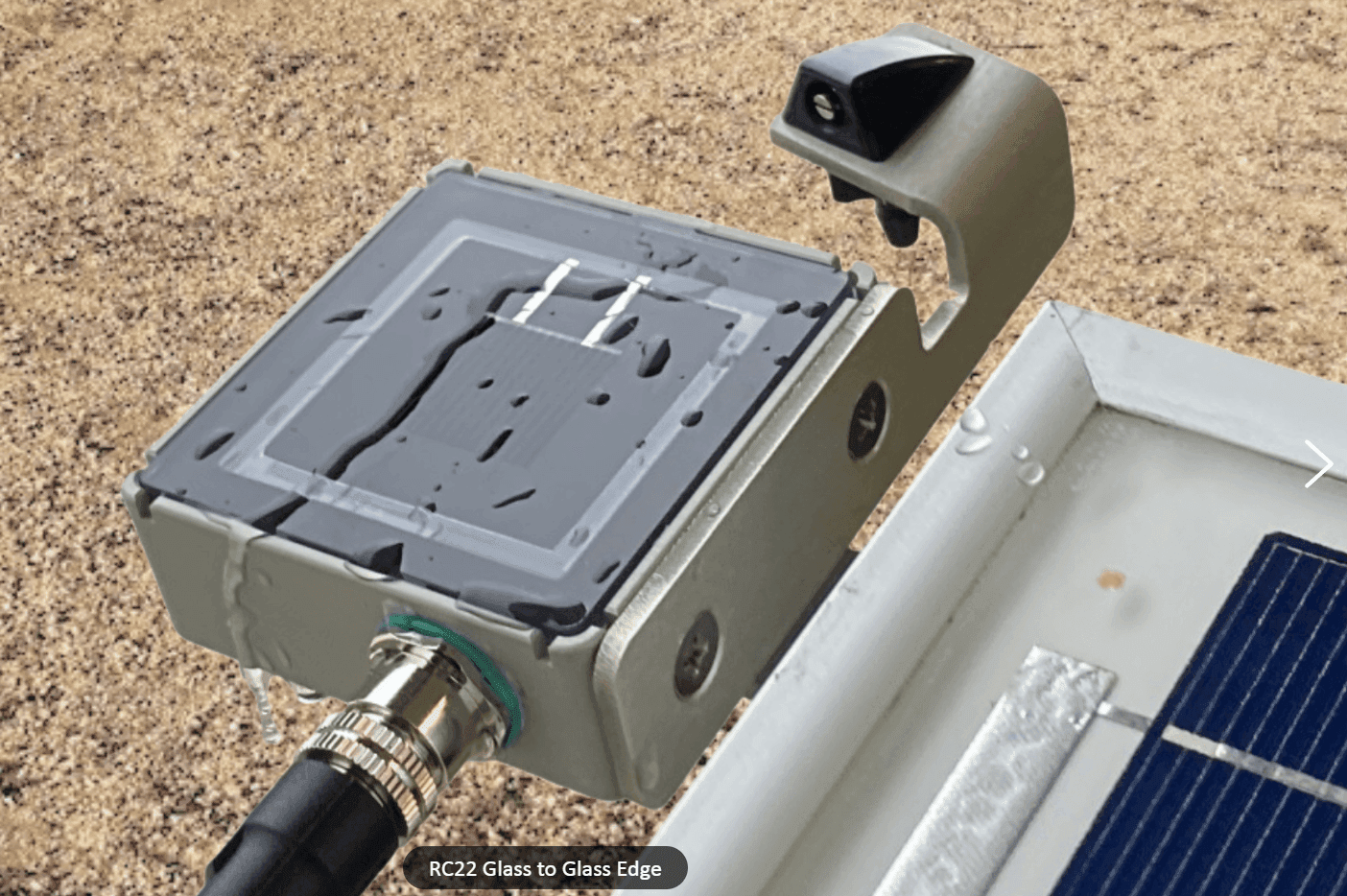
Dust buildup on the sensor surface (soiling effect) is the number-one “enemy” causing weather station data inaccuracies. Conventional sensors typically have a raised aluminum frame surrounding the glass surface. When it rains, water combined with dust tends to pool right at the aluminum edge, partially obscuring the sensor’s photovoltaic cell.
Recognizing this issue, Atonometrics equipped the RC22 with a glass-to-edge design with no obstructing rim. When it rains or when the sensor is tilted, water flows completely off the surface, automatically washing away dust. This feature extends the interval between periodic cleaning and maintenance, optimizing O&M costs.
2.3. The Most Compact Size in the Solar Industry
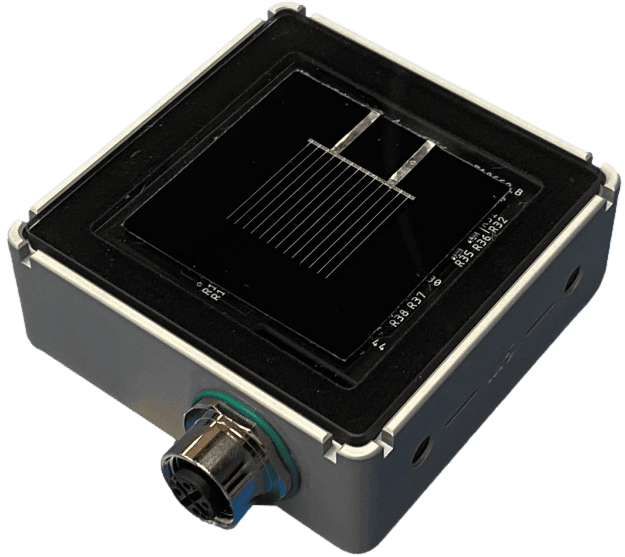
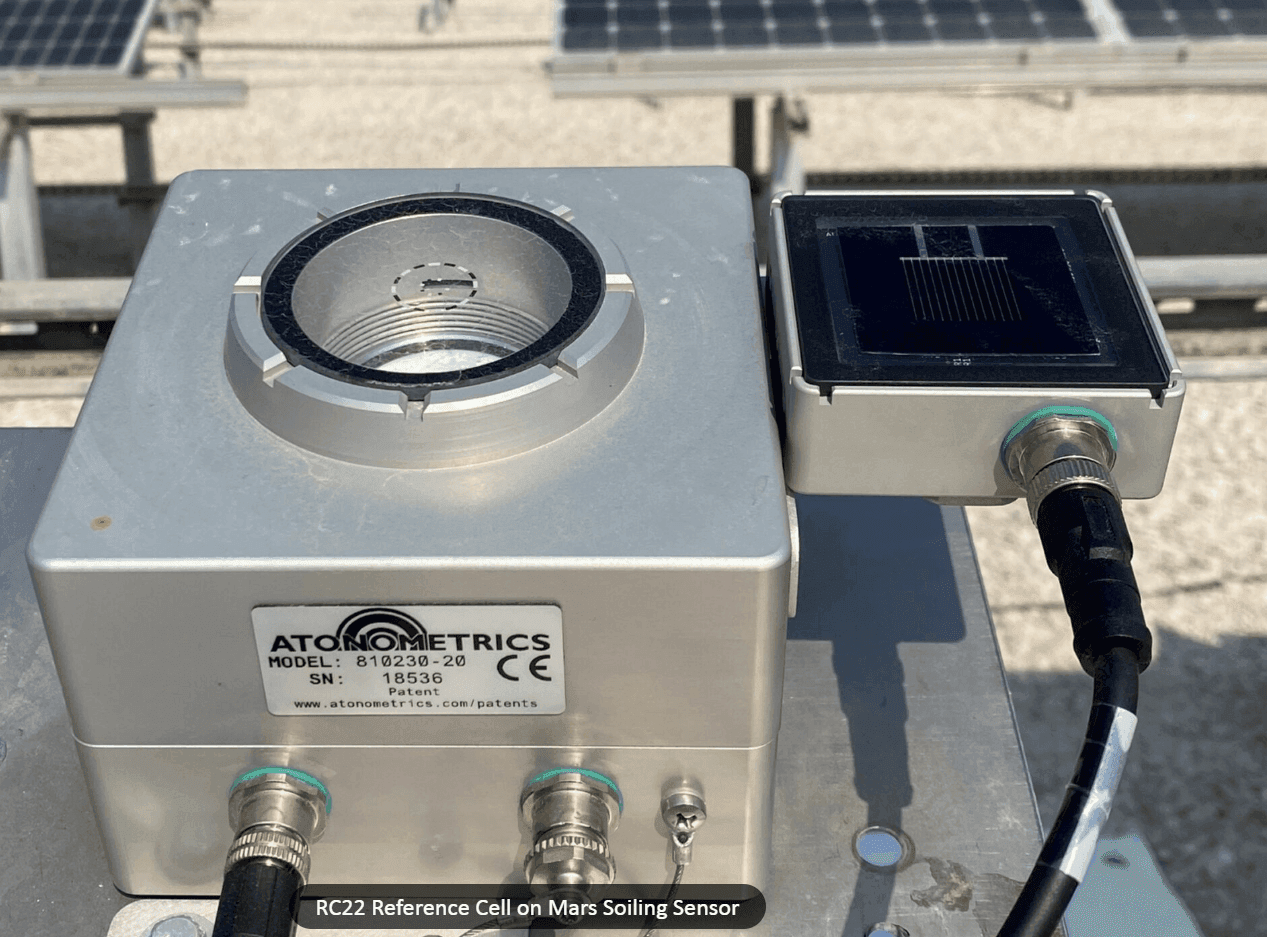
At just 2.6 inches (65 x 65 x 24.4 mm), the Atonometrics RC22 solar irradiance sensor is recognized as the smallest reference cell in the world today. This compact size delivers major benefits: the device produces virtually no shading on neighboring panels when mounted close to the panel mounting structure.
In addition, its ultra-light weight of just 170 grams makes the device easy to handle, without adding load stress onto auxiliary support arms.
2.4. Smart Sensor with Modbus RS485 Communication for Easy SCADA Integration
Instead of outputting an analog signal (mV voltage or 4-20mA current) that requires a complex ADC converter and is prone to interference over long transmission lines, the RC22 is a 100% “Digital Smart Sensor.” The device outputs a digital signal directly via the Modbus over RS485 (RTU) communication protocol.
All calibration data is stored internally within the device’s memory (internally calibrated). Engineers integrating SCADA systems no longer need to struggle with finding and manually entering variable constants into the data logger. The sensor supports a wide range of baud rates: 9600, 19200, 38400, and 57600 bps.
2.5. Exceptional Mechanical Durability with an IP67 Aluminum Housing
Solar farms are often built in areas with harsh weather conditions: intense heat, large temperature swings, dust, or coastal proximity. The RC22’s protective housing is made from premium anodized aluminum in a single-piece cast, achieving an absolute water- and dust-resistant rating of IP67.
The device’s operating temperature range extends to extreme levels, from -40°C to +80°C, ensuring its internal semiconductor components remain undamaged even during the scorching summer heat of Ninh Thuan and Binh Thuan provinces in Vietnam.
2.6. Convenient Installation with an Industry-Standard M12 Connector
To simplify fieldwork, Atonometrics integrated an industry-standard M12 5-pin circular connector port. The signal wires are shielded and UV-resistant. The signal through the cable head includes Power (10-30 VDC), Ground, RS485A, RS485 B, and a Shield wire.
When the periodic calibration is due (typically every 1-2 years), a technician simply loosens the M12 fitting, removes the old sensor, and installs the new one within one minute — no need to cut or rewire cumbersome connections. Cables of 4m, 10m, 25m, up to 100m in length are available for purchase from XBSolar.
3. Integrated Cell Temperature Measurement
In photovoltaic physics, temperature is the enemy of performance. As panel temperature rises, voltage (Vmp) drops, reducing output power. To accurately calculate the Performance Ratio (PR), the IEC 61724 standard requires simultaneous measurement of both irradiance and cell temperature.
Impressively, the Atonometrics RC22 solar irradiance sensor uses a standard 20mm x 20mm crystalline silicon cell, with an ultra-precise Pt1000 RTD temperature sensor mounted right behind the cell. It sends temperature data directly to the data logger alongside irradiance data. With just one device investment, you get the two most important parameters of a weather station.
4. Detailed Technical Specifications of the Atonometrics RC22 Irradiance Sensor
Below is a summary table of the core technical specifications extracted from the manufacturer’s official datasheet, demonstrating why this product meets the demanding IEC 61724-1 Class A and IEC 60904-2 standards.
| Technical Criteria | Specification & Value |
|---|---|
| Measurement range | 0 to 1500 W/m² (Supports high-intensity environments as well) |
| Digital resolution | 0.1 W/m² |
| Irradiance calibration accuracy | ±1.2% @ 1000 W/m² |
| PV cell type | Crystalline Si, 20 mm x 20 mm |
| Window material | Low-iron tempered solar glass |
| Input power | 10 – 30 VDC |
| Current consumption | Very low, typically only 10 mA |
| Communication protocol | Modbus over RS485 (RTU) – Self-configurable address |
| Temperature measurement (Cell Temp) | Ultra-precise Pt1000 RTD |
| Certifications and International Standards | IEC 61724-1 Class A, IEC 60904-2, CE |
5. Installation and System Optimization Guide
For the Atonometrics RC22 solar irradiance sensor to perform at its best, field engineers should keep the following in mind during installation:
- Front-side installation position (POA Irradiance): Install the sensor with a tilt angle and azimuth that match 100% of the actual solar panel array. The device is equipped with mounting holes on the sides and bottom, allowing it to be clamped securely onto the panel’s aluminum frame.
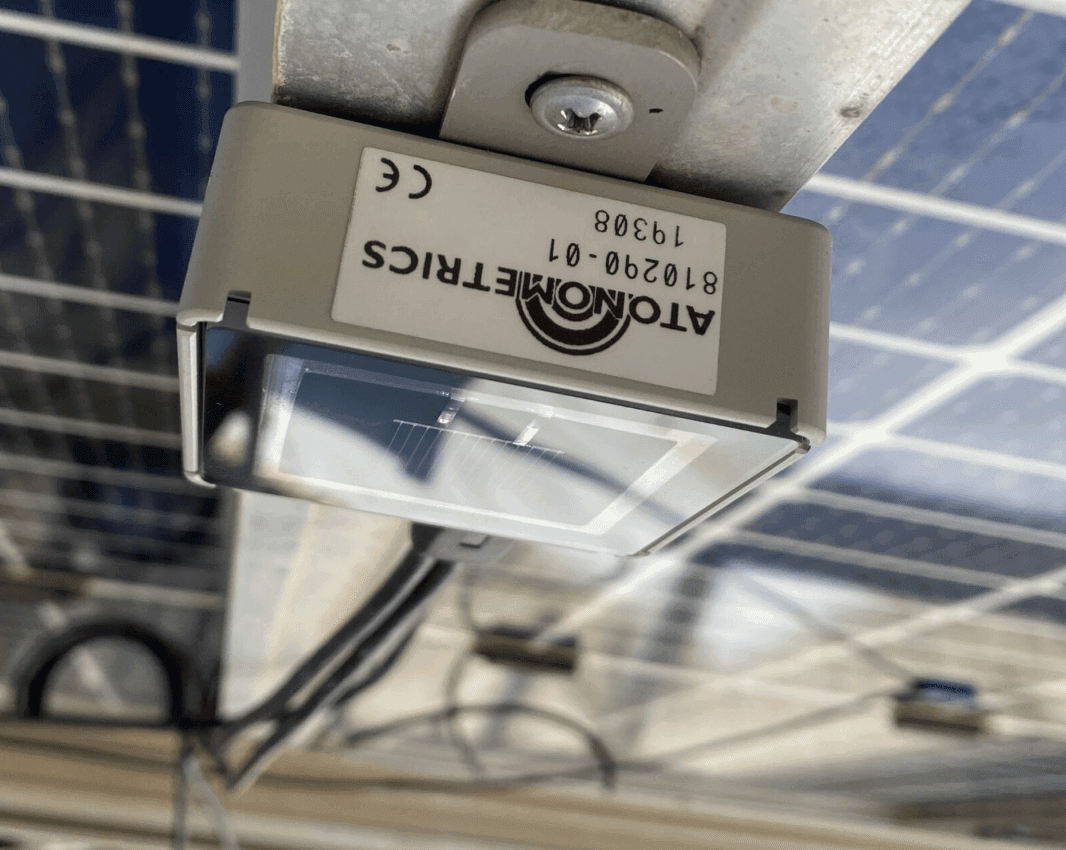
- Rear-side installation position (Rear-side Albedo): When measuring the reflectance coefficient for a bifacial system, mount the sensor facing down toward the ground at the same tilt angle. Ensure that the ground surface beneath the device is consistent with the entire plant area (avoid installing directly over abnormally tall grass patches or drainage ditches).
- Data logger configuration: Use the optional configuration kit to connect directly to a PC, using software to set the baud rate, parity, and slave ID for the device before connecting it into the SCADA system’s shared RS485 cable chain (daisy chain).
- Periodic maintenance: Despite its superior anti-soiling design, XBSolar still recommends gently wiping the glass surface with a soft microfiber cloth and distilled water every 3 to 6 months, depending on the dust levels at the project site.
6. Frequently Asked Questions (FAQ) About the Atonometrics RC22 Irradiance Sensor
Q: Can the RC22 sensor be used for standard (monofacial) solar power systems?
A: Absolutely. Although the RC22 was born with DNA heavily optimized for bifacial PV systems, the device still performs perfectly and achieves maximum accuracy on standard monofacial systems as well. Measuring 0-1500 W/m² on the front side has always been Atonometrics’ absolute strength.
Q: Why don’t I need to manually configure calibration parameters into the data logger for this sensor?
A: This is “Smart Digital” technology. The device has a small microprocessor inside, which has been pre-loaded at the Kipp & Zonen / Atonometrics factory with slope coefficients and noise compensation factors. The value transmitted via the RS485 Modbus line is already the final actual Watt/m² value. You simply read the corresponding register to get the result displayed directly on screen.
Q: Is the connector cable included when purchasing the device?
A: The M12 connector cable is not fixed to the device body; it’s a detachable cable. When purchasing from distribution partners such as XBSolar measurement equipment, you can choose from pre-molded cable lengths (4m, 10m, 25m, 50m, 100m) or Y-cable splitter types to best suit your station’s wiring layout, saving on unnecessary excess cable costs.
Where to Buy a Genuine Atonometrics RC22 Solar Irradiance Sensor?
The Atonometrics RC22 PV Reference Cell solar irradiance sensor is an advanced industrial-grade measurement device. To purchase a genuine product, guaranteed to meet international standards with full CO, CQ documentation and a calibration certificate, customers should choose partners with deep technical expertise.
XBSolar is proud to be a leading distributor and SCADA/data logger integration solution provider in Vietnam. We don’t just sell equipment — we also provide comprehensive technical consulting: help reading drawings, designing RS485 loop communication networks, guidance on data logger configuration programming, and dedicated troubleshooting support.
Partners and investors of Solar Farm or Rooftop C&I projects seeking consultation or a project quote, please contact XBSolar directly via Hotline or Email for the fastest response from our engineers!


